NUKR.
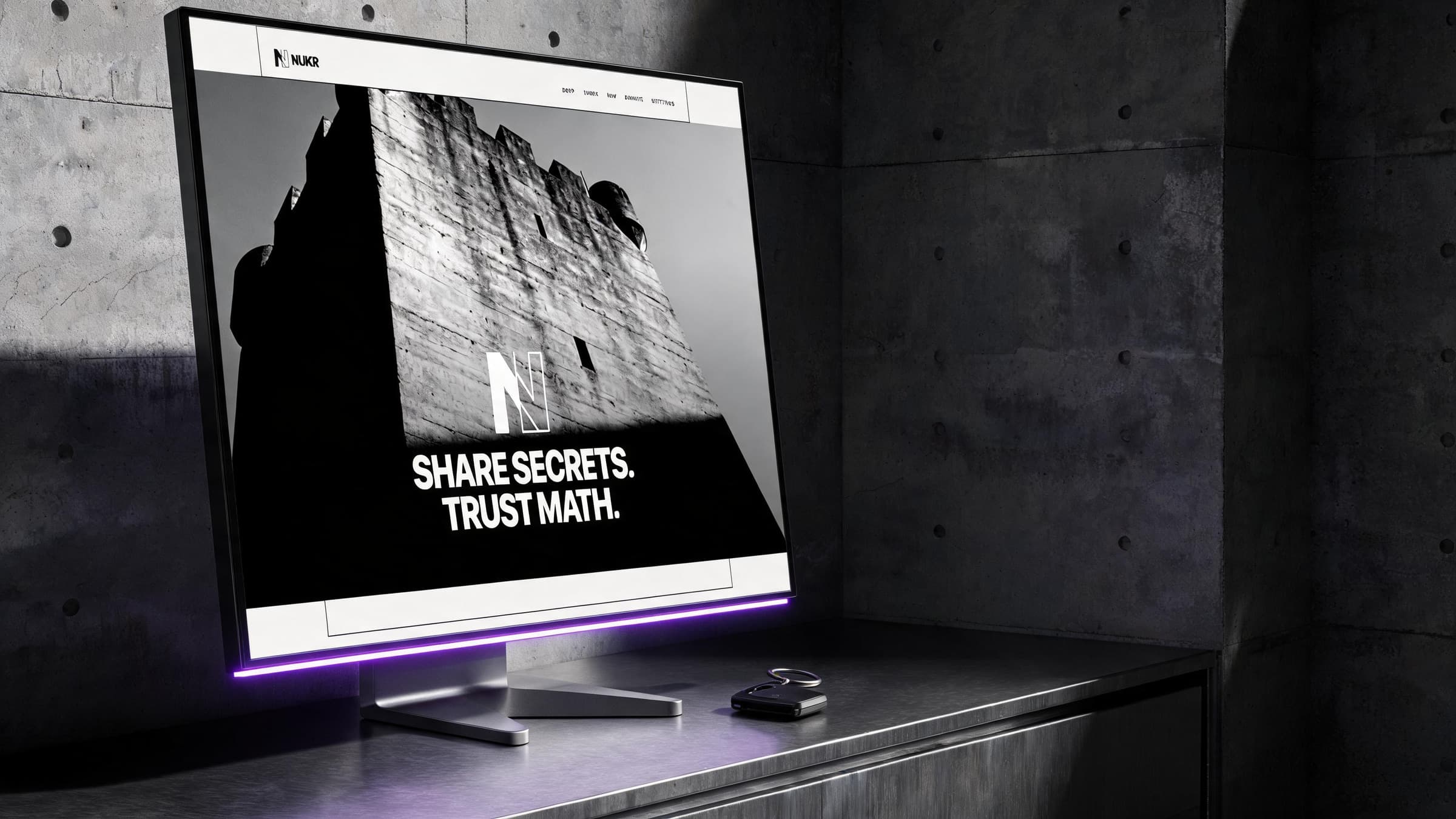
An encryption core being prepared for audit. Zero signup, device-held keys. Shared Rust + WASM crypto core powers a family of products – Drop, Bridge, Vault, Pay, Cash, Radio.
Roles
Cryptographic Architecture Rust + WASM Core PWA + Capacitor Mobile Threat Modelling Audit RFPProblem
Encrypted-messaging tools all rest on the same broken assumption: a single vendor server you have to trust, an account you have to create, and crypto primitives you can't independently verify.
The market is also fragmented by use case: Signal for chat, ProtonMail for e-mail, hardware Yubikeys for auth, hardware wallets for crypto. None share a key model. None share a wire format. None ship without a server in the threat model.
Approach
One crypto core. Many products. A single Rust encryption core
(nukr-core), being prepared for audit, provides every cryptographic
primitive – a hybrid KEM (ML-KEM-1024 + X25519), key-committing AEAD
(AES-256-GCM), hybrid signatures (Ed25519 + ML-DSA-65), and a versioned
envelope format with sealed-sender + Designated-Verifier MAC. WASM
bindings expose it to the browser, Capacitor wraps the same PWA on
iOS / Android, and a future N-API binding lands native Node.
Server never sees plaintext. Five axioms drive every design call: (1) server never sees plaintext, (2) private keys live on the device, (3) metadata minimised – inner metadata is encrypted, (4) envelopes are versioned for crypto agility, (5) no custom primitives – only standardised building blocks in clearly-specified combiners.
Being prepared for audit. The public v1 waits on an independent audit (the Cure53 / NCC Group RFP is in the docs). Pre-alpha builds are visible to invited testers only.
Product family
| Product | What it does |
|---|---|
| Drop | One-time encrypted share – paste a secret, scan a QR, the recipient reads it once. No account, no server-held copy. |
| Bridge | Long-form encrypted thread between two devices. Replaces "I'll DM you the password" forever. |
| Vault | Device-local encrypted blob storage with biometric unlock. Notes, credentials, recovery phrases. |
| Pay | Hybrid escrow for crypto payments – buyer + seller exchange via the same envelope format. |
| Cash | Encrypted balance ledger on top of Pay. Treat the device as the wallet. |
| Radio | Air-gapped hardware for the threat model where the device itself can't be trusted. |
Tech stack
- Rust workspace (
nukr-core) –nukr-crypto,nukr-envelope,nukr-otp,nukr-wasm,nukr-test-vectorscrates. Cross-runtime known-answer testing (Rust + WASM against RFC 7748, RFC 8032, plus internal hybrid + DV-MAC vectors). - WebAssembly –
wasm-bindgenwrapper exposes the entire core to TypeScript.@nukr/corenpm package consumes it. - TypeScript + Vite – PWA client (
nukr-web) withvite-plugin-pwa,vite-plugin-wasm, top-level-await for WASM init, SRI-3 for subresource integrity. - Capacitor 8 – same PWA wrapped natively on iOS + Android, with
biometric unlock (
@aparajita/capacitor-biometric-auth), camera for QR pairing, filesystem for vault storage, push notifications for Bridge. - Cryptographic primitives: ML-KEM-1024 (standardised KEM) + X25519 (classical KEM) hybrid via HKDF-SHA-512 dual-output combiner; Ed25519 + ML-DSA-65 hybrid signatures; AES-256-GCM as key-committing AEAD; envelope v2 (Mode B, sealed-sender, DV-MAC tag).
- No backend you have to trust – relay servers route opaque envelopes
only. Audit-friendly infrastructure (
nukr-infrastructurerepo).
Status
Pre-alpha across the board. Crypto primitives wired and passing cross-runtime tests against published vectors. Envelope wire format is at v2. The encryption core is being prepared for audit; the Cure53 / NCC Group RFP is in the docs and the audit gates the public v1.
If end-to-end encrypted infrastructure is a problem you care about – talk to me before v1 ships.
Pick
a week.
The one after,
we're building.

No slot fits? Send a brief →